Turn.io’s 2025 Chat for Health & AI Accelerator wraps up with AI-enabled solutions ready to scale across 35 million-strong networks
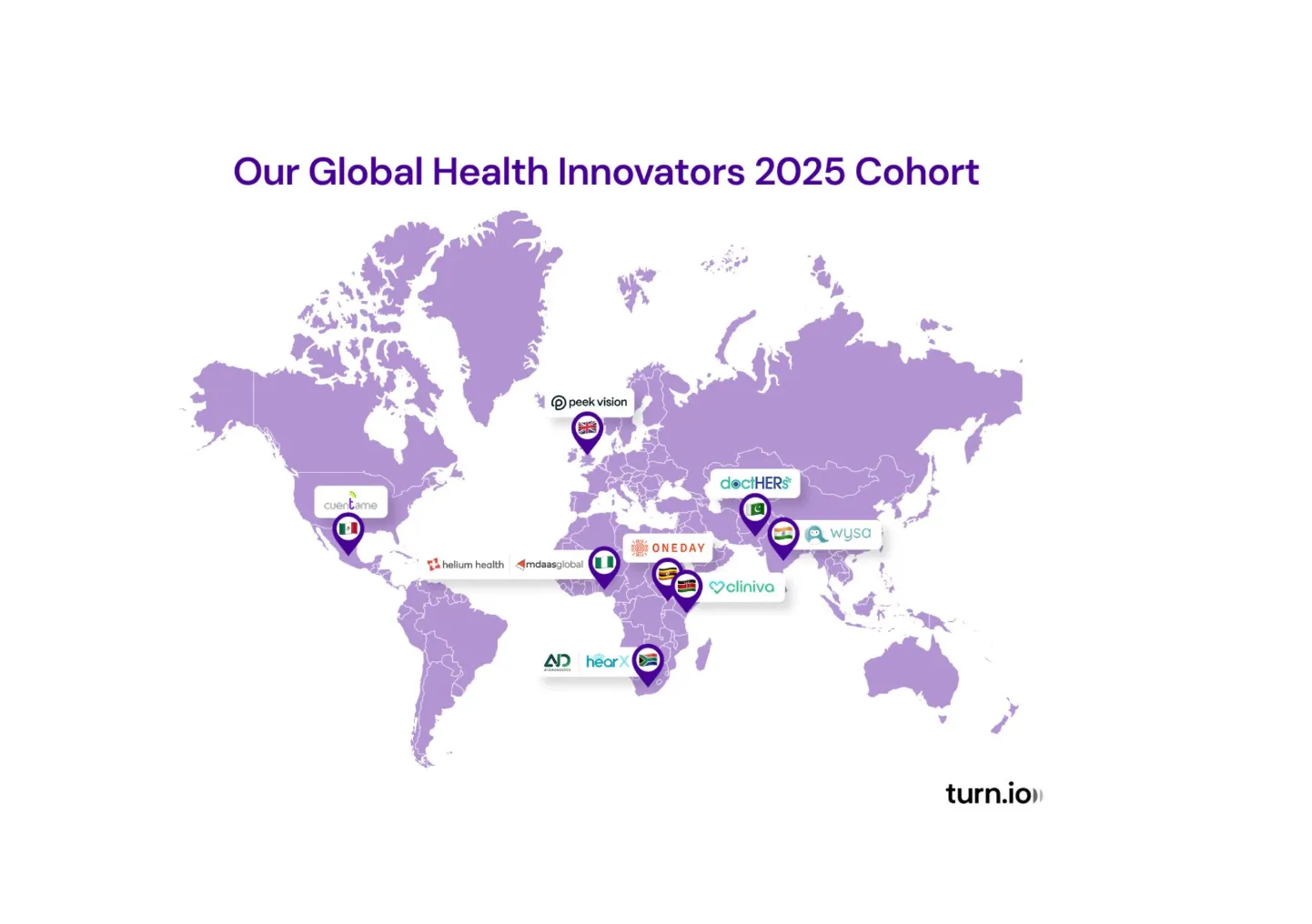
Turn.io today announced the completion of its 2025 Chat for Health & AI Accelerator, a 24-week programme that supported ten organisations in designing, building, and testing AI-enabled conversational health services on WhatsApp.
Supported by the Johnson & Johnson Foundation, Mulago Foundation, and OpenAI, the programme selected its cohort from over 400 global applications in September 2025.
During the programme, the cohort’s solutions were tested with users across multiple countries and are now positioned to scale across the cohort’s combined existing networks, which collectively reach more than 35 million people.
"What I saw during this accelerator was the development of practical solutions solving real-world problems in real care settings. The teams that delivered the most impact built inside existing workflows, kept humans in the loop, and focused on one clear problem. The results speak for themselves: start small, stay close to real care, and the impact follows." Lieze Langford, Head of Impact Accelerators at Turn.io.
Each organisation brought a different health challenge to the accelerator, and four were recognised for outstanding performance across impact and scale, practical AI innovation, and strong programme engagement.
Helium Health (Nigeria) – Appointment management and patient engagement
Helium Health, which serves more than 330,000 patients and over 100 clinics per month across Africa and the Middle East, built an end-to-end appointment management system on WhatsApp to tackle a persistent problem: only 49% of patients were attending booked visits. In a single month, the system drove over 5,500 new engagements. Today, 38% of daily appointments are booked through WhatsApp. One in three patients confirmed appointments through chat, 18.6% rescheduled in advance, and 11.5% proactively cancelled, reducing no-shows and improving operational insight. The team also launched a WhatsApp symptom checker, where 94% of users who engaged received guidance and proceeded to book an appointment.
Peek Vision (United Kingdom) – Frontline worker support for eye health screening
Peek Vision, which has helped eye health providers screen more than 18 million people and connect nearly 2 million to care across 13 countries, built and piloted Peek Assist, an AI-powered WhatsApp assistant for frontline eye health screeners. The service delivers instant, on-demand guidance grounded in curated internal knowledge in English, Hindi, Swahili, and Urdu. Routine queries are handled automatically while complex cases are routed to human operators. Tested with 142 users across five countries over two months, the system received strongly positive feedback. The organisation estimates each team member could gain at least 130 hours of productivity per quarter – time redirected to onboarding new partners and expanding screening reach.
hearX Foundation (South Africa) – Hearing care and teacher training at scale
hearX Foundation built two AI-enabled WhatsApp services: a Hearing Coach that supports new hearing aid users with voice notes, personalised reminders, and on-demand guidance in local languages; and an automated teacher training service for early identification of childhood hearing difficulties. Where manual implementation was previously limited to approximately 1 to 30 users, Turn.io integration expanded capacity to over 100,000 users. A pilot study with 2,500 community-based teachers validated the efficiency of WhatsApp-based training, shifting delivery from small, staff-led sessions to large-scale, simultaneous training with round-the-clock automated support. The initial scale target is 150,000 teachers, reaching an estimated 4.5 million children each year.
OneDay Health (Uganda) – Clinical decision support for remote nurse-led care
OneDay Health, which operates 75 nurse-led health centres and has treated more than 412,000 patients at an average cost of $2 per treatment, built OneDay Guide, a WhatsApp-based clinical chatbot that guides nurses through structured, guideline-based diagnostics. The AI agent responds only from validated internal clinical guidelines, not open internet sources. Tested with 107 nurses, it is now live with 10 nurses supporting care for more than 800 patients in the past month. An independent evaluation with the London School of Economics is underway, and following this, 50 nurses will use OneDay Guide to support care for 50,000 patients in 2026.
The remaining six organisations in the cohort tackled an equally diverse range of health challenges, from TB screening and women's preventive care to mental health access, maternal health, affordable diagnostics, and NHS referral pathways. These included;
AI Diagnostics (South Africa)
AI Diagnostics is an Health tech startup developing AI-enabled diagnostic tools, including a digital stethoscope for frontline TB and respiratory screening. Through the Accelerator, it piloted a WhatsApp service guiding nurses through patient onboarding, education, and treatment adherence in partnership with StopTB.
Cliniva (Kenya)
Cliniva is a nurse-led hybrid healthcare model serving over 60,000 women. Cliniva advanced AVA, a WhatsApp-based health prevention coach that turns clinical advice into daily behaviour support with personalised weekly goals, follow-up prompts, and AI-powered photo-based meal feedback.
Cuéntame (Mexico)
Cuéntame is a digital B2B mental health platform serving 150,000+ employees across 40+ companies in Latin America. Cuéntame redesigned onboarding for WhatsApp, enabling operational workers to sign up, complete stress assessments, and receive personalised care recommendations entirely through chat. Sign-up completion rates doubled and stress assessment completion reached 100%.
doctHERs (Pakistan)
doctHERs is a social enterprise that brings qualified female doctors back into the healthcare workforce through mobile health and telemedicine. The organisation built a comprehensive WhatsApp digital health hub replacing traditional helplines, and piloted multilingual voice-enabled AI tests with over 4,000 rural women and 100 frontline health workers.
MDaaS Global (Nigeria)
MDaaS Global operates 23 diagnostic centres connecting low-income Nigerians to affordable care. The organisation built Ask Beacon, a WhatsApp AI health concierge linked to its EazyLife membership model. Early results show follow-up rates improved sixfold, and 58% of users chose to consult a doctor first rather than self-medicating.
Wysa (US, UK, and India)
Wysa is an AI mental health platform supporting 11 million+ people and processing over 300,000 NHS referrals. Built a WhatsApp-based digital referral assistant replacing paper and phone-based intake with compassionate, multilingual, voice-enabled conversational flows to improve access for non-English speakers due to language barriers, literacy challenges and phone anxiety.
The cohort received over $500,000 in value which includes access to Turn.io’s technology suite including the Health Desk (an AI-enhanced team inbox), Journeys (a no-code chatbot builder), multimodal AI, voice calling, and AI voice agents – alongside expert mentorship across AI and conversational engineering, digital health and behaviour change, financial sustainability, and strategic communications from the Turn.io team, delivered in partnership with IDInsight.
The 24-week, three-phase programme ran from September 2025 through to early 2026, progressing from service design and technical implementation, through live testing and user validation, to scaling strategy and investor-ready preparation, culminating in a Demo Day on 27 January 2026.
Turn.io will continue to provide guidance and support to the cohort as they scale their health services. A 2026 Chat for Health & AI Accelerator is planned for later this year, details to be announced soon.